XNUT-105 Embedded communication computer with Ethernet and CAN
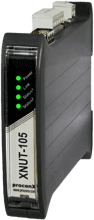
XNUT-105 is an open source, low-cost Ethernet single board computer with industrialized form-factor, DIN-rail enclosure, CAN interface and additional RS-232, RS-422 and RS-485 ports.
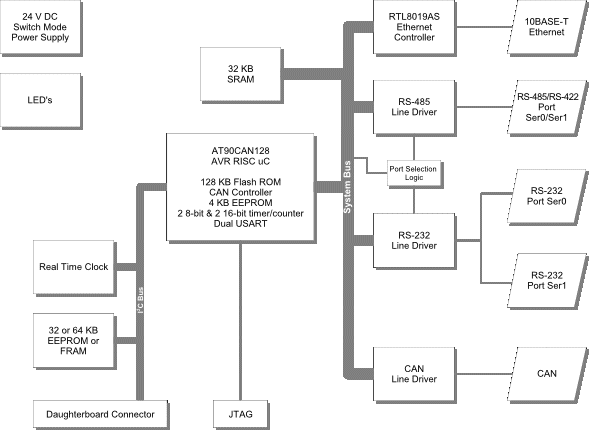
XNUT-105 is based upon the AVR AT90CAN128 CPU as it's core and the free open source RTOS and TCP/IP stack Nut/OS.
By using the freely available GNU GCC tool chain for Linux or Windows, and an open source TCP/IP stack, developers can quickly create custom CAN based Protocol Converter, Web Server and Fieldbus Gateway devices.
The perfect solution for equipment manufacturers who want to integrate
a Controller Area Network (CAN) into the world of
Ethernet and
Block Diagram
Downloads
| Manuals & Datasheets | |
|---|---|
| 2 page data sheet for the proconX XNUT-105 module w/ CAN | |
| Manual describing the hardware aspects of the proconX XNUT-105 module | |
| Introduction to the Nut/OS operating system (July 2009) | |
| Application Notes | |
| Difference between the XNUT-100 & XNUT-105 and the Ethernut 1 Hardware | |
| Installation of the AVR-GCC Compiler Toolchain | |
| Installation of Nut/OS 4 | |
| Configuration and Compilation of Nut/OS 4 | |
| Programming the Nut/OS httpd Example Application | |
| Fuse settings for the XNUT-100 and XNUT-105 CPUs | |
| Operating Systems & Libraries | |
| Nut/OS Windows Installer, version 4.4.1 (recommended version) | |
| Nut/OS XNUT platform tarball (Linux/Mac OS X/Free BSD), version 4.4.1 (recommended version) | |
| TFTP Ethernet bootloader for the XNUT-100/XNUT-105 modules, version 1.1 | |
| Board support library for the XNUT-100/XNUT-105 modules, version 1.0 | |
| Software Tools | |
| AVR-GCC compiler toolchain for XNUT-100/XNUT-105, version 20060421 (recommended version) | |
| Free Tftpd32 utility by Ph. Jounin | |
Development
Applications are developed in the C programming language with the choice of either the free AVR-GCC compiler on Linux and Windows development hosts or the commercial ICCV7 compiler from ImageCraft.Nut/OS' architecture has been focused on portable standards. Developers with experience in C programming and TCP/IP applications for the PC will soon feel confident. Existing software can be adapted for Nut/OS with minimal effort. The following example prints a message on the second serial port:
#include <stdio.h>
#include <dev/uartavr.h>
int main(void)
{
FILE *ser1;
NutRegisterDevice(&devUart1, 0, 0);
ser1 = fopen("uart1", "r+b");
fprintf(ser1, "Hello world!\n");
}
The Nut/OS operating system offers a feature rich API including Multi-threading, Device Driver, Stream I/O, Dynamic Memory, Timer, Events, Socket API and TCP/IP Protocols. At the same time Nut/OS is a very lean OS which is well suited for microcontroller CPUs and their small memory footprint. Typically more than 100 KB program space and 20 KB data memory are available for your application. Nut/OS can be used in commercial products for any purpose without licence fees (the full BSD-style license is here). Nut/OS comes with several sample applications, including an embedded web server and a RS-232 to Ethernet gateway.
Resources
The following list is a collection of unsupported resources suitable for the XUT-105. These resources are provided and maintained by third parties.
| Manuals and Datasheets | |
|---|---|
| Latest version of Atmel's CPU datasheet. | |
| Atmel's migration guide showing the differences between ATmega128 and AT90CAN128 CPUs. | |
| Free Windows based Development Tools | |
| Free Development Environment for writing and debugging AVR applications by Atmel. Integrates with AVR-GCC (WinAVR). | |
| Ready to install collection of AVR-GCC compiler, debugger and avr-libc runtime library for Windows. | |
| Free Tftpd32 utility by Ph. Jounin. Can be used in conjunction with the TFTP Bootloader to program the XNUT/XNUT-105 modules over the network. | |
| Linux based Development Tools | |
| Debian package of the GNU C cross compiler for AVR. | |
| Debian package of the GNU Binary utilities supporting Atmel's AVR targets | |
| Debian package of the GNU Debugger for AVR. | |
| The AVR Libc C runtime library for the AVR family of microcontrollers. For use with AVR-GCC compiler. | |
| Programming software for Atmel AVR microcontrollers | |
| RTOS and TCP/IP stacks | |
| Open Source Real Time Operating System and TCP/IP protocol suite. | |
| Forums and Mailing lists | |
| Forum of the Nut/OS and Ethernut user community. | |
| Official forum about AVR Libc development. | |
| Official forum about the AVR-GCC compiler toolchain. | |
Specifications
-
Nut/OS RTOS and embedded TCP/IP stack
-
XNUT Library for on-board hardware support
-
WinAVR gcc compiler and C run-time library
-
Ethernet TFTP bootloader
-
Optional AVRStudio IDE & source level debugger
-
Optional SPDuo low-cost JTAG programmer
-
Optional AVR JTAGICE mkII in-circuit JTAG programmer/debugger
-
Ethernet port (IEEE 802.3i 10BASE-T) with 8-pin RJ-45 socket
-
CAN interface (ISO 11898) with DE9M connector, CiA DS-102 pin-out
-
Two serial ports, software configurable as:
-
1 EIA-232-F DE9M port with EIA-574 DTE pinout and RD, TD, RTS, CTS, DSR, DTR
[DSR and DTR only available for devices with serial number 224 upwards (since PCB Revision C).]
, DCD, RI signals -
1 EIA-232-F DE9M port with EIA-574 DTE pinout and RXD, TXD signals
-
2 EIA-485-A 2-wire ports with A-,B+ signals
-
1 EIA-422-B port with RD+, RD-, TD+, TD- signals
-
-
Atmel AT90CAN128 RISC micro controller with Harvard architecture
-
12 MIPS processing speed
-
Full CAN controller
-
Programmable watchdog timer
-
Brown-out detection
-
Realtek RTL8019AS network interface controller
-
Two 8-bit & two 16-bit timer/counter
-
Optional battery buffered real time clock (RTC)
-
LED indicators for power, Ethernet link and two bi-color status
-
JTAG programming interface (IEEE 1149.1) with 10-pin header
-
128 KiB program memory
-
32 KiB static RAM for data
-
4 KiB EEPROM
-
optional 64 KiB EEPROM
-
10 kV ESD protection on RS-232/RS-485/422 ports
-
6 kV ESD protection on CAN port
-
1.5 kV galv. isolation on Ethernet
-
10-30 V DC, 750 mW
-
30 mA typical @ 24 V DC
-
0 to 60 °C (32 to 140 °F) operating temperature
-
-25 to 85 °C (-13 to 185 °F) storage temperature, max. 70 °C if RTC is fitted
-
10 to 95% humidity, non-condensing
-
Free from corrosive gas, minimal dust
-
35 mm DIN rail mountable enclosure, self-extinguishing PC/ABS blend (UL 94-V0)
-
IP 20 / NEMA Type 1 protection rating
-
101 x 22.5 x 120 mm (3.98 x 0.886 x 4.72 in) w/ enclosure
-
0.13 kg (0.287 lbs)
Ordering
proconX products can be ordered online from our web store:
Alternatively you can contact one of our distributors:
![]() |
|
egnite GmbH Erinstrasse 9 44575 Castrop-Rauxel Deutschland Telefon: +49 (0) 2305-441256 Fax: +49 (0) 2305-441487 Web: www.egnite.de |
Open Source Ethernet = "Ethernut"
The Ethernut project is an Open Source platform for building Embedded Ethernet Devices.It's license provides royalty free, commercial use in both open and closed source projects.
Features
- Free Development Toolkit with compiler and debugger (open-source)
- Free Real-Time Operating System with TCP/IP stack (open-source)
- Ethernet port
- RS-232, RS-485 and RS-422 ports
- CAN port
- DIN Rail mountable
- 10-30 V DC power supply
- Atmel AT90CAN128 CPU
- Realtek RTL8019AS Network Interface Controller
- 128 KB Flash ROM
- 32 KB static RAM
- Dual USART
- CAN 2.0A & 2.0B controller with 15 message objects and time stamping
- Status LEDs
- JTAG in-circuit programming & debugging port
- Ethernut 1.3 hardware compatible