proconX: Protocol Converter & Gateways

Serial Device Server

Smart Industrial Communication and Embeddeded Ethernet Solutions
 Login 
We accept VISA, MasterCard, PayPal

World Wide Shipping

Serial to Ethernet Converter and Gateway

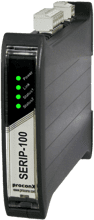
The SERIP-100 is proconX' low-cost Industrial device server offering one or two software selectable RS-232/422/485 serial ports and a 10 Mbit Ethernet port.

The SERIP-100 acts as an interface converter and connects a serial device to Ethernet. It support a variety of different operating modes and can act as client and server.
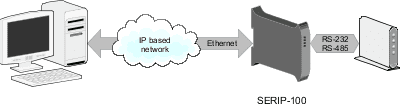
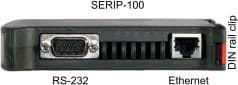
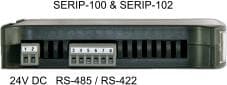
With it's DIN-rail enclosure and 10-30 V DC power supply it is easy to install in automation panels and switchboards. Cables are fed in from top and bottom and makes wiring of the communication ports easy.

The unit's firmware adheres to the Internet Standards (RFCs) as close a possible. This provides it with a high degree of compatibility with a broad range of available commercial and open source middleware, drivers and utilities.

Keeping in line with the proconX Range of products, the SERIP-100 features Web Page configuration and firmware upgrade over the network.
SERIP-100 Device Server Key Features Features SERIP-100 Device Server Key Features SERIP-100 Device Server Brief Description Brief Description SERIP-100 Device Server Brief Description SERIP-100 Device Server Specifications Specifications SERIP-100 Device Server Specifications
 

Modes of Operation

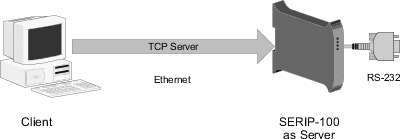
TCP Server Mode

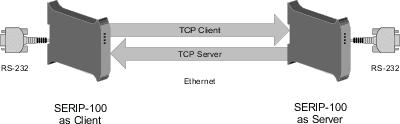
The SERIP-100 Interface Converter operates as a Server listening on the configured TCP port for connections from a Client. As soon as one client is connected, it will receive the serial port data stream via TCP. Any data sent to the SERIP-100 Interface Converter by the Client will be forwarded to the serial port. The Server Mode is the most commonly used and is utilised by the telnet utility as well as serial port redi-rectors and virtual serial port device drivers.

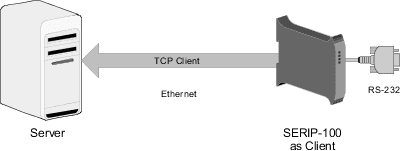
TCP Client Mode

The SERIP-100 Interface Converter requires a TCP Server to connect to. After a connec-tion to the nominated Server has been established, any data received on the serial port is delivered to the Server as TCP data stream. Any data sent to SERIP-100 Inter-face Converter by the Server will be forwarded to the serial port. The SERIP-100 Interface Converter will automatically re-connect to the specified Server if the connec-tion has been lost. This mode is also known as "reverse Telnet".

UDP Tunnelling

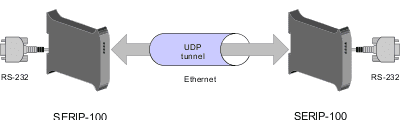
This mode utilises the UDP protocol for receiving and sending data. It does not require a connection between a server and a client, instead it requires a nominated peer where to send data. Any data received on the nominated UDP port is streamed to the serial port. If data is received on the serial port, it is embedded into a UDP packet and sent to the nominated peer. UDP tunnelling supports broadcast-ing of received serial data to the local subnet. UDP tunnelling is typically used to connect two SERIP-100 Interface Converter in order to extend the range of a RS-232 link.